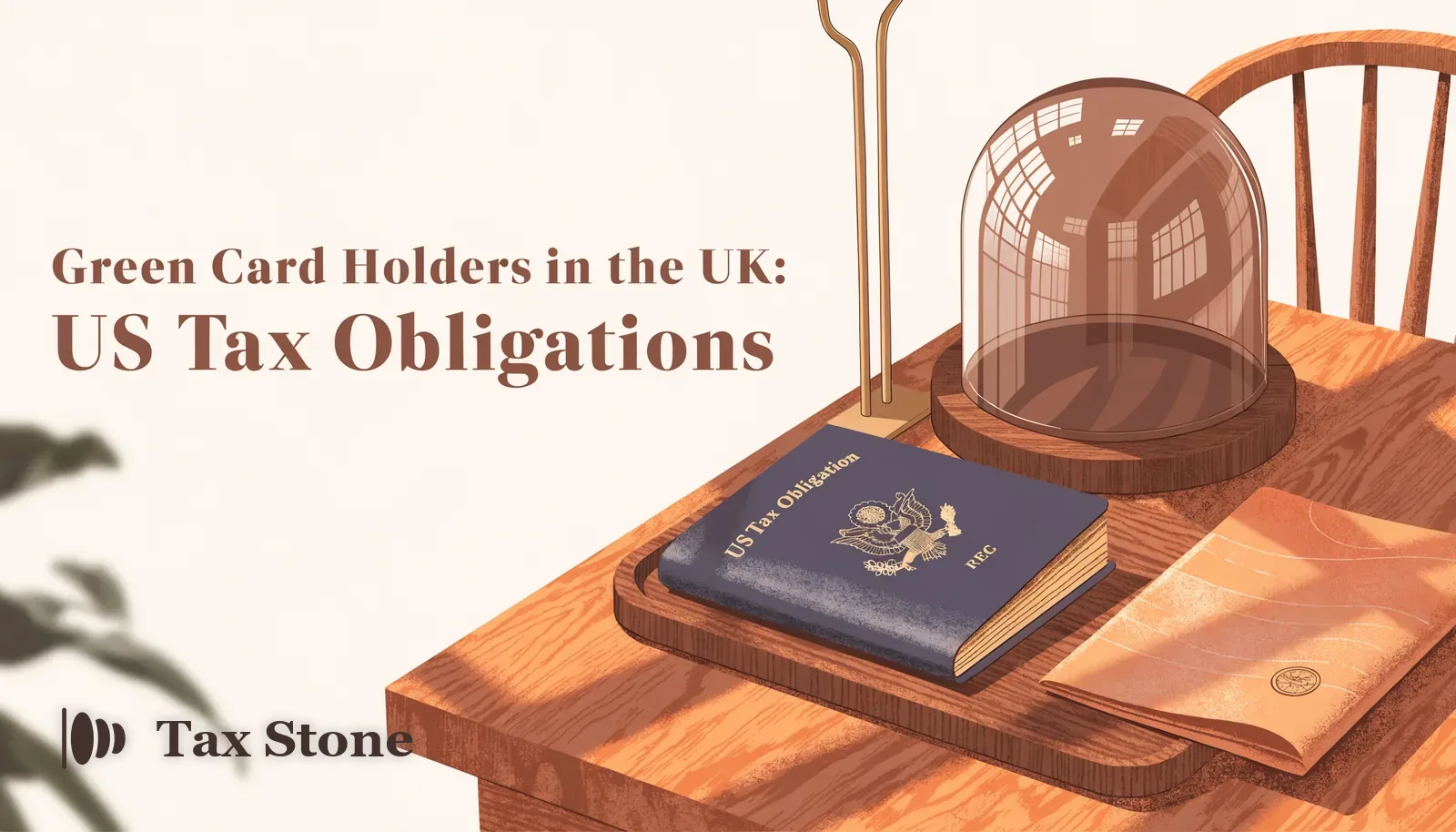
If you hold a US Green Card and live in the UK, the IRS treats you almost exactly like a US citizen: you are taxed on your worldwide income, you must file a US tax return every year, and you have the same FBAR and FATCA reporting duties — no matter how long you have been out of the United States. Many lawful permanent residents assume that living abroad pauses their US obligations, or that handing the card back is a simple immigration step. Neither is true, and both assumptions can be expensive. This guide sets out what you actually owe, the costly exit-tax trap, the state-tax angle people forget, and how to stay compliant in 2026 — whether you plan to keep the card for life or eventually give it up.
Green Card = US tax resident, wherever you live
A Green Card makes you a US lawful permanent resident, and for tax purposes that means you are a US tax resident under the "green card test" — taxed on worldwide income just like a citizen. Your UK salary, UK rental income, UK investments and UK pensions are all reportable to the IRS, even though you also pay UK tax on them.
This obligation continues for as long as your Green Card is valid, and in some cases even after you stop using it, until you formally abandon it. If you are new to US filing from Britain, start with our overview of how US tax returns work for Americans in the UK — the mechanics are the same for Green Card holders.
What you must file each year
If your UK accounts and FATCA position are unclear, our guide to FBAR vs FATCA breaks down which filing applies and at what threshold.
- Form 1040 — your annual US return reporting worldwide income.
- Form 2555 or Form 1116 — to claim the Foreign Earned Income Exclusion or the Foreign Tax Credit and avoid double taxation.
- FinCEN 114 (FBAR) — if your combined UK and other non-US accounts topped $10,000 at any point in the year.
- Form 8938 (FATCA) — if your foreign financial assets exceed $200,000 at year-end (single, abroad) or $400,000 (married filing jointly).
- Form 8621 — for UK funds and Stocks & Shares ISAs, which usually fall under the PFIC rules.
The treaty does not let you off
Like citizens, Green Card holders are caught by the US/UK treaty's saving clause, which lets the United States keep taxing its residents under normal US rules. So you cannot simply point to the treaty to switch off US tax — see our explainer on how the US–UK tax treaty really works. In practice you rely on the Foreign Tax Credit for UK tax paid, which usually removes the US bill because UK rates are typically higher.
There is a subtle and dangerous wrinkle here: a Green Card holder who claims to be a UK tax resident under the treaty's tie-breaker rules (to be taxed as a non-resident alien) can be treated by US immigration authorities as having abandoned their Green Card. The IRS warns about this directly. Never take a treaty residence position on your Green Card without specialist advice.
The exit tax: the trap when you give up the card
The biggest financial risk for long-term Green Card holders is the US expatriation (exit) tax. If you are a "long-term resident" — broadly, someone who held a Green Card in at least 8 of the last 15 tax years — and you give it up, you may be treated as a "covered expatriate" and subject to a deemed sale of your worldwide assets, taxed as if you sold everything the day before you left.
You are generally a covered expatriate if you exceed certain net-worth or average-tax thresholds or cannot certify five years of US tax compliance. The mechanics run through Form 8854, and the IRS sets out the expatriation rules in detail. The key lesson: giving up a long-held Green Card is a tax event that must be planned years ahead, not a simple immigration formality.
Reliefs that keep your US bill low
- Foreign Tax Credit (Form 1116) — credits UK tax paid against US tax on the same income; usually the most powerful tool in the UK.
- Foreign Earned Income Exclusion (Form 2555) — excludes up to $130,000 of earned income for 2025 ($132,900 for 2026).
- Treaty positions — limited, because of the saving clause, but relevant for some pension and double-tax situations.
- The refundable Child Tax Credit — available if you have qualifying US-resident or citizen children; see our Child Tax Credit guide.
Why compliance matters for your immigration status
For Green Card holders there is more at stake than tax. US immigration law expects permanent residents to meet their tax obligations, and a history of not filing US returns — or filing as a non-resident — can create problems when you renew your card, re-enter the US, or apply for citizenship. Staying current with the IRS is part of protecting the Green Card itself.
If you have fallen behind, you are not stuck: the IRS Streamlined Foreign Offshore Procedures let non-willful filers catch up on three years of returns and six years of FBARs, usually penalty-free.
Your first and last years: dual-status rules
The year you receive a Green Card and the year you give it up are special. In your first year as a permanent resident you may be a "dual-status" taxpayer — a non-resident for part of the year and a resident for the rest — which changes how your income is taxed and which deductions you can claim. The same applies in the year you abandon the card. These transition years are some of the most error-prone on a cross-border return, because income has to be split correctly across the residency start or end date.
If you moved to the UK part-way through a year, or are planning to hand back your card, the dual-status mechanics are worth getting professional help with rather than attempting in off-the-shelf software, which often handles them poorly. A first US return after a move is covered in our guide to how US tax returns work for Americans in the UK.
Don't forget US state tax
Federal tax is only part of the picture. Some US states are aggressive about continuing to treat you as a resident even after you move abroad, particularly if you keep ties such as a home, a driver's licence, voter registration, or bank accounts. States like California, New York, Virginia and New Mexico are well known for this. A Green Card holder who moved to the UK from one of these states may still have a state filing obligation, and state tax is not covered by the federal Foreign Tax Credit or the US/UK treaty.
Before you assume your only US filing is federal, check whether your last state of residence still considers you a taxpayer. Cutting state ties cleanly when you leave can save years of unnecessary state returns.
A worked example
Consider a Green Card holder who has lived and worked in London for six years on a UK salary, with a workplace pension and a Stocks & Shares ISA. Each year she files a US Form 1040 reporting her worldwide income, uses the Foreign Tax Credit to offset the UK tax she has already paid (which eliminates her US income-tax bill), files an FBAR because her UK accounts exceed $10,000, and files Form 8621 for the funds inside her ISA. She owes no US tax — but every one of those filings is required, and skipping the ISA's PFIC reporting or the FBAR is exactly where penalties arise. The work is in the compliance, not the tax.
Common mistakes Green Card holders make
The errors we see most often come from a single false assumption: that living abroad reduces your US obligations. In reality, the opposite is usually true — distance adds reporting requirements rather than removing them. Green Card holders frequently stop filing US returns after a few years abroad, believing that paying UK tax is enough. It is not, and the gap can quietly build into years of missed FBARs and unfiled returns that then need a streamlined catch-up to resolve.
Another common error is mishandling UK investments. A Green Card holder who opens a Stocks & Shares ISA for its UK tax advantages can unknowingly create an annual PFIC reporting burden and US tax on gains the UK never touches. Similarly, treating a UK workplace pension as invisible to the IRS, or taking a tax-free lump sum without checking the US treatment, can produce nasty surprises. The lesson is consistent: every significant UK financial decision deserves a quick check of its US consequences before you act, not after.
What to do now
If you hold a Green Card in the UK, three things keep you safe: file your 1040 every year (even when you owe nothing), report your UK accounts on the FBAR and Form 8938, and get advice before doing anything that changes your status — surrendering the card, claiming treaty residence, or taking a large pension lump sum. A US tax specialist who understands the UK side can keep your filings clean and flag the exit-tax line before you cross it.