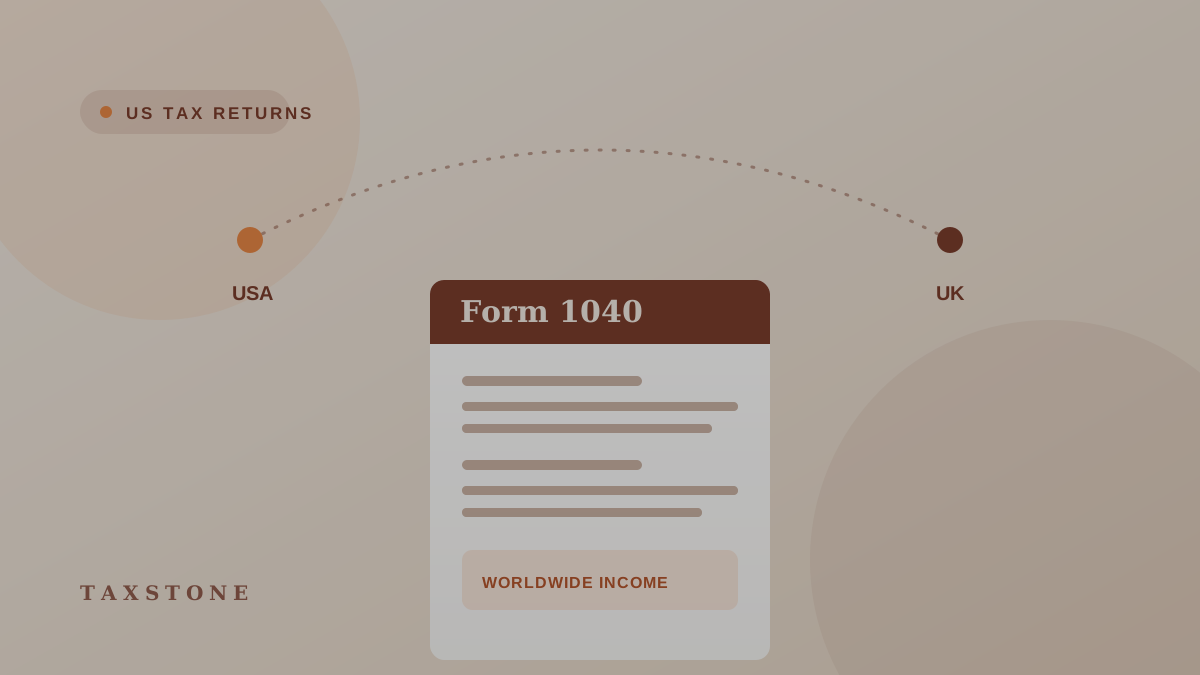
Here is the fact that surprises almost every American who moves to Britain: you still have to file a US tax return every year, even though you live in the UK, pay UK tax, and may owe the IRS nothing at all. The United States taxes based on citizenship, not residence. This guide walks through how US tax returns work for Americans in the UK — filing a 1040 from abroad, the deadlines that apply to you, and the reliefs that usually wipe out any US bill.
Why you file at all: citizenship-based taxation
The US is one of the only countries on earth that taxes its citizens and Green Card holders on their worldwide income regardless of where they live. So your UK salary, UK self-employment, UK rental income and UK investment income are all visible to the IRS. The good news: a set of reliefs — the Foreign Earned Income Exclusion and the Foreign Tax Credit — exist precisely so you are not taxed twice on the same income.
Who actually has to file
Most Americans abroad meet a filing threshold without realising it, because the income thresholds are low and the self-employment threshold is tiny.
- Employees: you generally must file if your worldwide income exceeds the standard deduction for your status (tax year 2025: $15,750 single, $31,500 married filing jointly).
- Self-employed: you must file once net self-employment earnings reach just $400 — regardless of any exclusion.
- Married to a non-American: special rules apply, and "married filing separately" has a very low filing threshold.
- Even if you owe nothing: filing is still how you claim the exclusions and credits that make your bill zero — they are not automatic.
The deadlines that apply to Americans abroad
- 15 April 2026 — standard deadline, and the date any US tax owed must be paid.
- 15 June 2026 — automatic 2-month extension to file for those living abroad. No form required.
- 15 October 2026 — extended deadline if you file Form 4868 by 15 June.
- 15 December 2026 — further discretionary extension by written request, granted in limited cases.
- 15 April → automatic 15 October — the FBAR (FinCEN 114) deadline, extended automatically with no form.
The core forms in a typical UK filer's return
- Form 1040 — your main return, reporting worldwide income.
- Form 2555 — claims the Foreign Earned Income Exclusion (up to $130,000 of earned income for tax year 2025).
- Form 1116 — claims the Foreign Tax Credit for UK tax you have already paid.
- FinCEN 114 (FBAR) — required if your non-US accounts together topped $10,000 at any point in the year.
- Form 8938 (FATCA) — required if your foreign financial assets exceed $200,000 on the last day of the year ($400,000 married filing jointly) for those living abroad.
- Form 8621 — one for each PFIC you hold, which usually captures UK funds and many Stocks & Shares ISAs.
FEIE vs Foreign Tax Credit: the choice that matters most
The two main reliefs work differently, and picking the right one (or the right combination) is where a specialist earns their fee.
The Foreign Earned Income Exclusion (Form 2555) simply removes up to $130,000 of earned income (2025) from US tax. It is powerful if your UK tax rate is low or you have mostly earned income.
The Foreign Tax Credit (Form 1116) gives you a dollar-for-dollar credit for UK tax paid. Because UK tax rates are often higher than US rates, this frequently wipes out your US bill entirely and can build up carry-forward credits — and, unlike the exclusion, it does not stop you claiming the refundable Child Tax Credit.
Where UK life trips up a US return
- ISAs are not tax-free to the IRS — the US ignores the wrapper, and any funds inside are usually PFICs.
- Workplace pensions and SIPPs almost always need to go on your FBAR, and sometimes Form 8938.
- UK "accumulation" funds can create US taxable income even when you receive no cash.
- Selling your UK main home can be UK tax-free but partly US-taxable above the US exclusion limit.
Filing a 1040 from abroad, in practice
Mechanically, filing a 1040 abroad is much like filing at home: most returns can be e-filed, refunds can be paid to a US account, and tax due can be paid online to the IRS. The differences are the extra international forms, the currency conversion of every UK figure into US dollars, and the separate e-filing of the FBAR through FinCEN's BSA system rather than with the return. Get those three things right and the rest is routine.