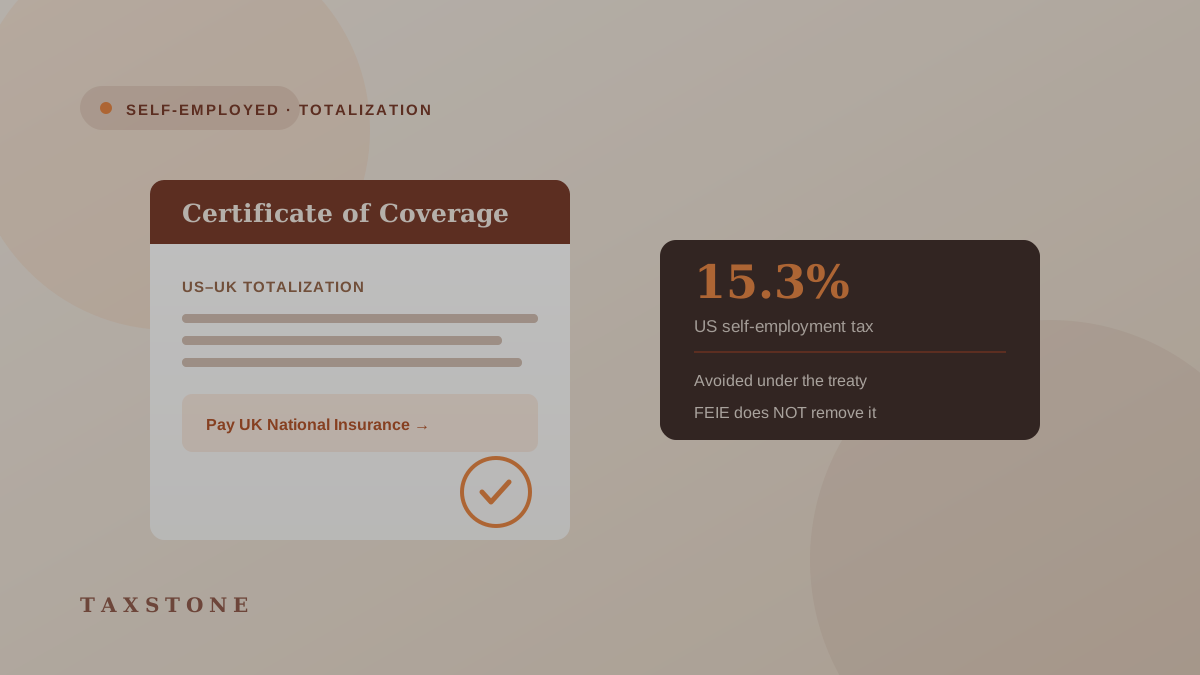
If you are a self-employed American — a freelancer, contractor, consultant or sole trader — living and working in the UK, you can usually avoid the 15.3% US self-employment tax under the US-UK totalization agreement, paying UK National Insurance instead. This matters enormously, because the one tax the Foreign Earned Income Exclusion does not remove is self-employment tax. Without the treaty you could be paying into both the US and UK social-security systems on the same profit. This guide explains how the totalization agreement works for the self-employed, how to claim the exemption with a certificate of coverage, and how to choose a cross-border specialist who handles this correctly.
The double Social Security problem
The United States levies self-employment (SE) tax — Social Security and Medicare — on the worldwide self-employment income of its citizens and Green Card holders, wherever they live. The UK levies National Insurance on the self-employed who work in Britain. Left unchecked, a self-employed American in the UK would be charged twice on the same profit: 15.3% US SE tax and UK National Insurance on top. The income-tax side of double taxation is solved by the foreign tax credit and the FEIE, but neither of those touches SE tax — that is the specific problem the totalization agreement was designed to fix.
What the US-UK totalization agreement does
A totalization agreement is a bilateral Social Security treaty that decides which country's social-security system you contribute to, so you only pay into one. The US has these agreements with around 30 countries, and the UK is one of them — the SSA's US-UK agreement page sets out the detail, and the IRS overview of totalization agreements explains how it interacts with your US return. The agreement assigns your coverage to one system and exempts you from the other, and it also lets you combine (totalize) credits from both countries when working out future benefit entitlement so that time abroad does not leave you short.
How coverage is assigned for the self-employed
For self-employed people, the US-UK agreement generally assigns coverage based on where you live. A self-employed US citizen who is resident in the UK is normally covered by the UK system, pays UK National Insurance, and is therefore exempt from US self-employment tax. This is different from employees, where the rules turn more on which employer sends you and for how long (a temporarily seconded worker can stay in their home system for up to five years under the agreement). For a freelancer who has genuinely based themselves in Britain, the answer is usually clean: you are in the UK system.
- Self-employed and resident in the UK → covered by the UK, pay UK National Insurance, exempt from US SE tax.
- Self-employed and resident in the US but working temporarily in the UK → may remain in the US system.
- Employees follow separate rules based on the posting and its expected duration.
- You contribute to one country's system, never both, on the same earnings.
The certificate of coverage
To prove to the IRS that you are exempt from US self-employment tax, you need a certificate of coverage from the country whose system covers you. For a self-employed American resident in the UK, that means a certificate from HMRC confirming you are subject to UK National Insurance. You apply to HMRC — see the GOV.UK guidance on National Insurance if you work abroad — and you keep the certificate as evidence. The IRS asks you to retain the certificate and, where required, attach a statement to your US return claiming the exemption rather than completing Schedule SE.
US self-employment tax basics (what you avoid)
It helps to know exactly what the agreement saves you. US self-employment tax is charged on your net self-employment profit and is made up of two parts. The figures below are for the 2025 tax year, drawn from the IRS self-employment tax pages:
- Combined SE tax rate: 15.3% — being 12.4% Social Security plus 2.9% Medicare.
- Social Security portion (12.4%) applies up to the 2025 wage base of $176,100; the Medicare portion (2.9%) has no cap.
- An additional 0.9% Medicare tax applies to self-employment income above $200,000 (single) or $250,000 (married filing jointly).
- You owe SE tax once your net self-employment earnings reach $400 for the year.
- SE tax is separate from income tax — and is not removed by the Foreign Earned Income Exclusion or the foreign tax credit.
Why the FEIE does not help with SE tax
This is the mistake we see most often. A self-employed American reads that the Foreign Earned Income Exclusion removes their US tax, files Form 2555, and assumes they owe nothing. But the FEIE only excludes income from income tax — it does not touch self-employment tax. So a freelancer can correctly exclude all their earnings from US income tax and still face a 15.3% SE tax bill on the full profit. The only thing that removes the SE tax is the totalization agreement plus a certificate of coverage. Getting this wrong is expensive and common, which is why pairing the FEIE or foreign tax credit with the totalization exemption is the heart of getting a self-employed expat return right.
Claiming the exemption on your US return
Mechanically, when you are covered by the UK system you do not file Schedule SE for that income. Instead the IRS asks you to note the exemption — typically by attaching a statement to your Form 1040 explaining that your self-employment income is covered by the UK under the US-UK totalization agreement, and keeping your HMRC certificate of coverage on file as proof. Your business income still goes on Schedule C as normal; it is only the SE tax computation on Schedule SE that you are exempt from. Our broader walkthrough of how US tax returns work for Americans in the UK puts this in context with the rest of your filing.
What about a UK limited company?
Many UK freelancers operate through a limited company rather than as a sole trader, and that changes the picture. A limited company is a separate legal person; you typically take a salary and dividends rather than self-employment profit, so US self-employment tax may not arise in the same way — but a new set of US issues does, including controlled foreign corporation rules, GILTI, and Form 5471 reporting on your ownership of a foreign company. This is materially more complex than sole-trader filing, and the wrong structure or a missed Form 5471 can be costly. If you run, or are thinking of forming, a UK company, treat it as a specialist matter from day one.
How to choose a specialist for self-employed Americans in the UK
Self-employed cross-border returns are where generic preparers most often slip — applying the FEIE but forgetting that SE tax still needs the treaty, or missing the certificate of coverage entirely. When choosing an adviser, look for someone who lives in both systems and can prove it. Our guide to choosing a US tax specialist in the UK goes deeper, but for the self-employed specifically, check the points below — and see who we help and our services for how we work with freelancers and contractors.
- They confirm, in writing, how the totalization agreement applies to your situation — not a vague reassurance.
- They handle the HMRC certificate of coverage and the US-side statement, rather than leaving it to you.
- They model the FEIE versus the foreign tax credit and pair the right one with the SE-tax exemption.
- They are fluent in PFICs, FBAR and Form 8938 on your business and personal accounts.
- If you use a UK limited company, they are comfortable with Form 5471, GILTI and the CFC rules.
- They quote a fixed fee up front and are qualified on the US side (Enrolled Agent or CPA).
Getting it right from the start
The totalization agreement is one of the most valuable provisions available to a self-employed American in the UK — it can save you the entire 15.3% self-employment tax — but it only works if it is claimed correctly and documented with a certificate of coverage. Combine that with the right income-tax tool and clean foreign-account reporting, and a freelance or contracting career in Britain becomes far less taxing on both sides of the Atlantic. If you have been filing without claiming the exemption, it can usually be fixed, sometimes through the IRS streamlined procedures if you also have other catching-up to do.