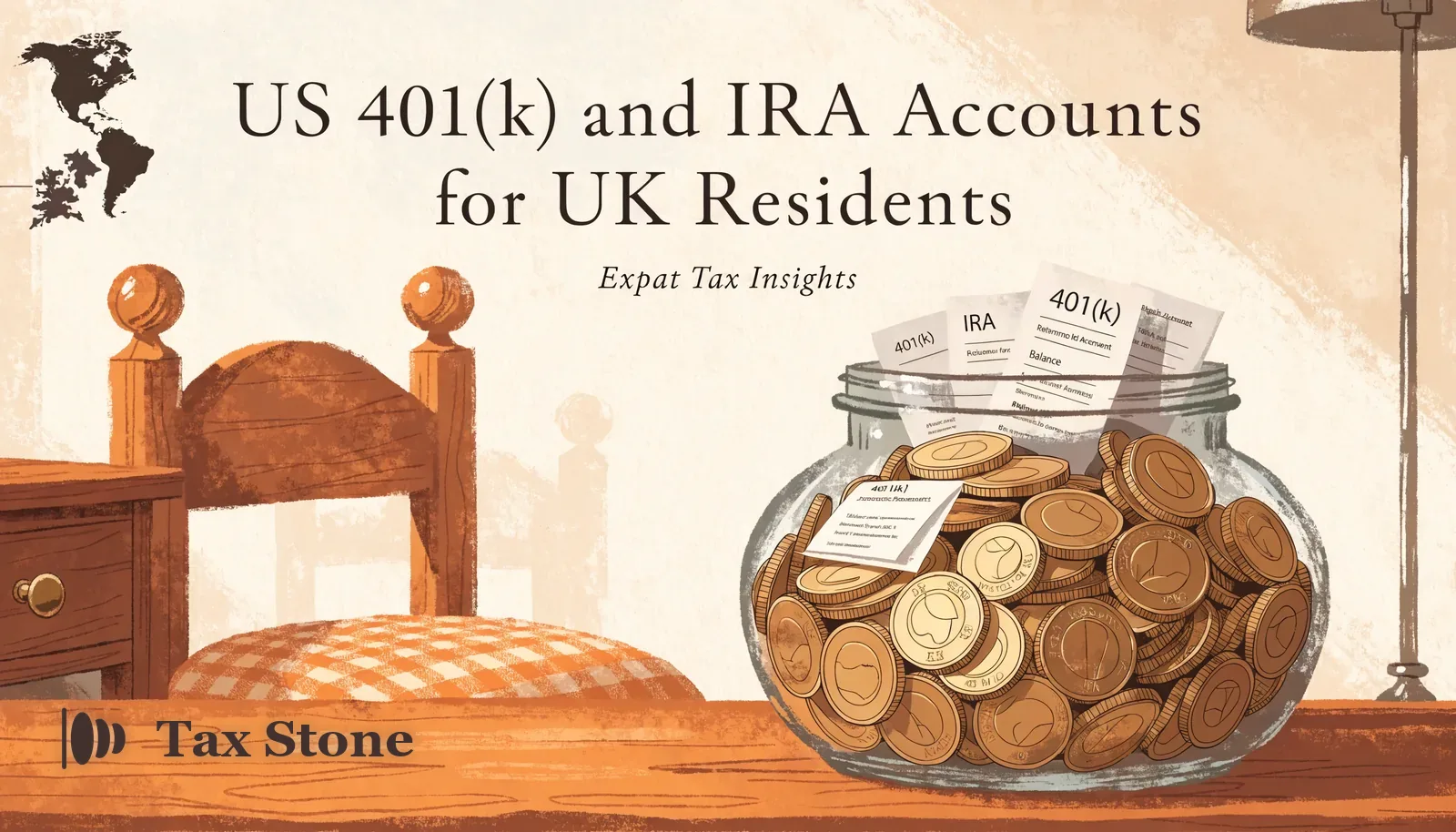
If you built up a US 401(k) or IRA before moving to the UK, the big question is simple: who taxes it when you draw it — the US, the UK, or both? The short answer is that the US/UK tax treaty generally gives the UK (your country of residence) the right to tax regular pension income, but the detail varies a lot by account type. Traditional 401(k)s and IRAs are taxable when you draw them, Roth IRAs can be tax-free on both sides, and lump sums sit in a contested grey area. Here is how each one works for a UK resident in 2026, and where the traps are.
The treaty starting point: residence taxes pensions
The foundation is Article 17 of the US/UK tax treaty, which broadly says that pensions and similar payments are taxable only in the country where the recipient is resident. So for an American living in the UK drawing a US 401(k) or IRA, the UK generally has the primary right to tax the income. That sounds clean — but, as with everything in cross-border tax, the saving clause in the US/UK treaty and the different rules for lump sums and Roth accounts complicate the picture.
In practice, you usually do not escape US tax entirely either; instead, the two systems are reconciled with the Foreign Tax Credit so the same money is not taxed twice. The result depends heavily on whether you are taking regular income, a lump sum, or a Roth distribution.
Traditional 401(k) and IRA distributions
A traditional 401(k) and a traditional IRA are funded with pre-tax dollars, so the money has never been taxed. When you draw it in retirement, it is taxable income. For a UK resident, regular periodic distributions are generally taxable in the UK under the treaty, and you report them on your UK Self Assessment. Because you are also a US person, you report the same income on your US return, then use the Foreign Tax Credit to avoid double taxation.
The key point is that these are ordinary taxable withdrawals on both sides — there is no magic that makes a traditional 401(k) or IRA tax-free in the UK. The treaty decides which country taxes first and ensures relief; it does not exempt the income. If you are new to coordinating the two systems, our overview of how US tax returns work for Americans in the UK sets out the basics.
The Roth IRA — the genuinely good news
Roth IRAs are the bright spot. A Roth IRA is funded with after-tax dollars, and qualified distributions are tax-free in the US. Crucially, the US/UK treaty's definition of a pension scheme expressly includes Roth IRAs (established under section 408A of the US tax code). The widely held professional view is that a properly qualified Roth distribution can be tax-free in the UK as well as in the US — a rare case where a US account stays tax-free on both sides of the Atlantic.
There is a condition: the treaty protection depends on the distribution genuinely being a qualified Roth distribution for US purposes (broadly, the account has been open five years and you are over 59½, or another qualifying event applies). Get that right and the Roth is one of the most tax-efficient accounts an American in the UK can hold. It is exactly the kind of position worth confirming with a US tax specialist who understands the UK side before you rely on it.
Lump sums: the contested grey area
Lump-sum withdrawals are where the treaty gets messy. Article 17(2) says a lump sum from a pension scheme established in one country and paid to a resident of the other is taxable only in the country where the scheme is established — which would point to US-only taxation of a US 401(k) or IRA lump sum taken by a UK resident.
However, HMRC has more recently taken the position that such lump sums are subject to UK tax, with a Foreign Tax Credit for any US tax paid. The result is that the treatment of a large one-off withdrawal is genuinely uncertain and fact-specific, and taking a big lump sum without modelling both the US and UK consequences can be an expensive mistake. The principle mirrors the 25% tax-free UK pension lump sum trap that catches people moving the other way: never assume a lump sum is tax-free on either side until it has been checked.
US Social Security for UK residents
Although not a 401(k) or IRA, US Social Security often comes up alongside them. Under the treaty, US Social Security benefits paid to a UK resident are generally taxable only in the UK — the US does not tax them at source for a UK resident. This is a relatively clean outcome compared with private pensions, but it still has to be reported correctly on your UK return, and it interacts with your overall position.
Can you still contribute while living in the UK?
Contributing to a US IRA from the UK is possible but constrained. To contribute to an IRA you need US taxable compensation — and if you exclude all of your earned income using the Foreign Earned Income Exclusion, you may have no eligible compensation left to support a contribution. Using the Foreign Tax Credit instead of the exclusion can preserve the income needed to contribute. Employer 401(k) contributions generally require US employment, so most UK-based Americans are no longer adding to these accounts and are focused on how to draw them efficiently.
Rollovers, early withdrawals and the 10% penalty
- 401(k)-to-IRA rollovers — moving a US 401(k) into a US IRA is generally a non-taxable event if done correctly, and can simplify management, but the UK treatment of the rollover should be confirmed first.
- Early withdrawals — taking money from a traditional 401(k) or IRA before age 59½ usually triggers a 10% US early-withdrawal penalty on top of income tax. The treaty does not remove this penalty.
- Required minimum distributions — traditional accounts have US RMD rules forcing withdrawals from a set age; these become UK-taxable income when drawn.
Do you report US 401(k)s and IRAs on the FBAR?
Here is a point of relief: a 401(k) or IRA held with a US institution is a US account, not a foreign one, so it does not go on your FBAR or Form 8938 — those forms are for your UK and other non-US accounts. (Your UK pensions, ISAs and bank accounts are what trigger FBAR and FATCA reporting.) The flip side is the UK reporting: once you are UK-resident, your US pension income generally has to be declared to HMRC, so the reporting burden shifts to the UK side for these accounts.
Planning your US retirement income from the UK
Because traditional accounts, Roths and lump sums are treated so differently, the order and timing of withdrawals matters enormously. Drawing Roth money (often tax-free both sides), spreading traditional withdrawals to manage UK tax bands, coordinating with your US Social Security, and avoiding large lump sums in a single year can all reduce the total tax you pay across both countries. The official treaty text and technical explanation are available via the IRS US-UK tax treaty documents, and the UK side is summarised on GOV.UK's foreign pensions guidance.
Leaving your US accounts untouched while abroad
Some Americans in the UK simply leave their 401(k) and IRA invested and do not draw on them for years. That is generally fine from a tax perspective — the growth inside a US 401(k) or IRA is not taxed annually by the US, and the UK broadly respects the deferral on a recognised pension while it remains undrawn. The tax event is the withdrawal, not the growth. What does need attention is the practical side: some US brokers restrict accounts held by UK-resident clients, so it is worth checking that your provider will keep servicing your account from abroad before you assume nothing needs doing.
It is also worth keeping the accounts under review rather than forgetting about them, because the most tax-efficient way to draw them later depends on decisions made years earlier — for example, whether to do a Roth conversion while your other income is low, or how to sequence withdrawals against your UK tax bands in retirement.
Estate and beneficiary considerations
US retirement accounts also carry estate-planning consequences that look different once you live in the UK. Beneficiary designations on a 401(k) or IRA, the US rules for inherited retirement accounts, and the interaction with UK inheritance tax can combine in ways that catch families out — particularly where a beneficiary is a non-US person or lives in the UK. This is specialist territory and very fact-specific, but it is worth flagging that your US retirement accounts should be part of your cross-border estate planning, not treated in isolation. A coordinated US/UK adviser can make sure the beneficiary arrangements work sensibly under both systems.
Common mistakes we see
- Assuming a traditional 401(k) or IRA is tax-free in the UK — it is taxable when drawn.
- Taking a large lump sum without modelling the contested US/UK treatment.
- Not confirming that a Roth distribution is actually qualified before relying on tax-free treatment.
- Excluding all income with the FEIE and then being unable to contribute to a US IRA.
- Forgetting that early withdrawals still attract the 10% US penalty.