If you are a US citizen or Green Card holder living in the UK, your UK pension is not invisible to the IRS. As a US person you are taxed on your worldwide income, so UK workplace pensions, SIPPs (Self-Invested Personal Pensions) and the State Pension all have to be considered on your US return — even though the same money is built up in a UK-tax-favoured wrapper. The good news is that the US-UK tax treaty and the foreign tax credit usually stop you being taxed twice. The bad news is that one of Britain's most popular retirement perks — the 25% tax-free lump sum — is often fully taxable in the United States. This guide explains how UK pensions are taxed by the US, how to report them, and where the real traps are.
Are UK pensions taxable in the US?
In principle, yes. The United States taxes its citizens and Green Card holders on their worldwide income regardless of where they live, so distributions from a UK pension are reportable on your US Form 1040. What the US-UK tax treaty does is decide which country gets to tax the income first and provide relief from double taxation — usually through the foreign tax credit on Form 1116. Because UK income-tax rates on pension income are frequently as high as or higher than the equivalent US rates, the UK tax you pay often wipes out the US tax due on the same payment.
The contributions phase and the withdrawal phase are treated differently. Most US-qualified advisers take the position that growth inside a UK workplace pension or SIPP is not currently taxed by the US year on year (it is the distributions that are taxed when paid). But this rests on treaty interpretation, not a blanket statutory exemption, and the analysis can differ between a broad-based employer scheme and a personal SIPP. If you are new to US filing from the UK, start with our overview of how US tax returns work for Americans living in the UK.
The 25% tax-free lump sum trap
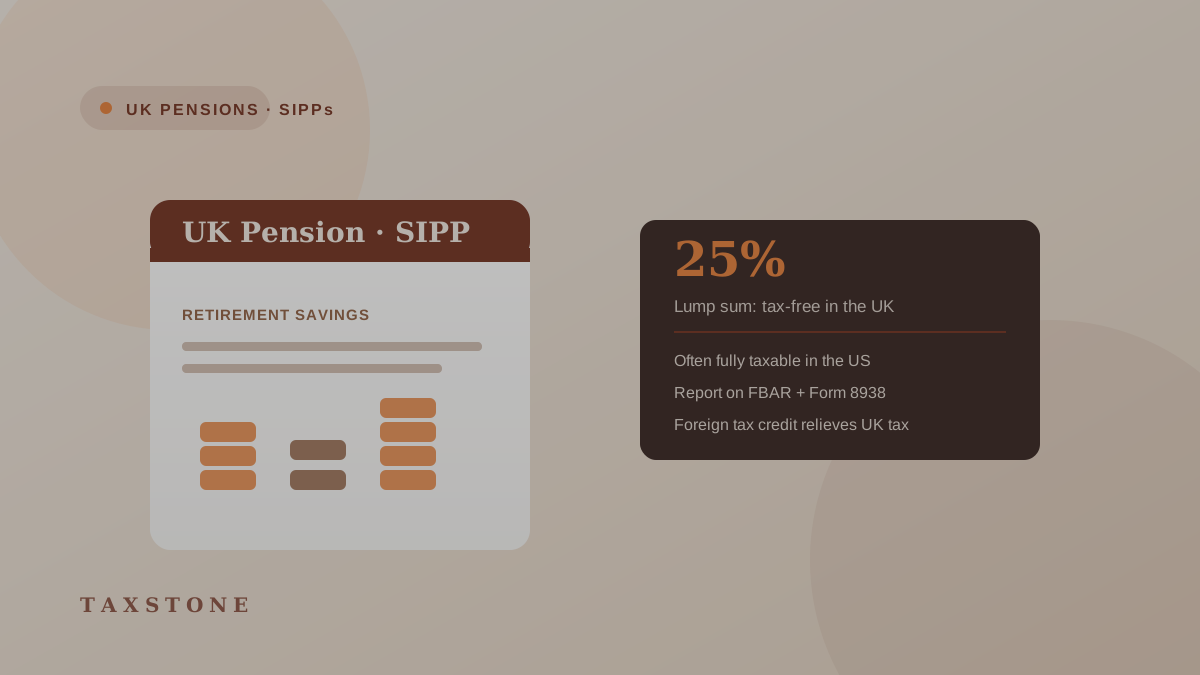
This is the single most misunderstood issue for Americans in the UK. When you reach pension age you can usually take 25% of your UK pension as a tax-free lump sum (a Pension Commencement Lump Sum), subject to the overall Lump Sum Allowance of £268,275 for 2025/26 — see the GOV.UK guidance on the lump sum allowance. In the UK that 25% is genuinely tax-free.
The problem is that the US does not automatically follow the UK's tax-free treatment. The treaty's saving clause lets the United States continue to tax its own citizens largely as if the treaty did not exist, and the IRS's typical position is that a partial 25% lump sum does not clearly qualify for the narrow treaty exemption — so it is treated as fully taxable ordinary income on your US return. Many expats assume that because HMRC charged nothing, the IRS will follow suit; that assumption can produce a surprise US tax bill, because there is little or no UK tax on that payment to claim as a foreign tax credit.
How SIPPs are treated for US tax
A SIPP is a personal pension you control, and for US purposes its treatment is more debated than an employer scheme. Practitioners generally argue a SIPP is a pension under the treaty rather than a taxable foreign grantor trust, but the IRS has never issued definitive guidance confirming this for personal pensions, so positions vary. What is not in doubt is the reporting: a SIPP is a foreign financial account and must be considered for both the FBAR and Form 8938.
There is a second, sharper trap inside SIPPs — the investments they hold. UK funds, unit trusts and OEICs held inside a SIPP are foreign mutual funds and can be Passive Foreign Investment Companies (PFICs). The pension wrapper may shelter them from the punishing PFIC regime while they sit inside the pension, but holding the same funds outside a recognised pension is a different story. We cover this in detail in our guide to PFIC rules and UK ISAs.
Workplace and employer pensions
Defined-contribution workplace pensions (the auto-enrolment schemes most UK employees now have) and older defined-benefit (final salary) pensions are generally accepted by US-qualified advisers as treaty pensions. The common position is that employer and employee contributions within reasonable limits, and the growth inside the scheme, are not currently taxed by the US — tax falls due when you draw the pension. Drawdown income and annuity payments are then reported as pension income on your 1040, with the foreign tax credit relieving the UK tax already paid.
Defined-benefit schemes raise an extra wrinkle: because you do not own an identifiable account balance, valuing them for Form 8938 and the FBAR can be awkward. The pragmatic approach is to report the cash-equivalent transfer value or the best available valuation and document your method.
- Auto-enrolment / workplace DC pensions: usually treated as treaty pensions; report distributions, not annual growth.
- Defined-benefit (final salary) pensions: treaty pensions, but valuation for FBAR/8938 needs care.
- Employer contributions: generally not treated as current US taxable income for a broad-based scheme.
- Investment growth inside the wrapper: commonly not taxed year on year, but this rests on treaty position, not statute.
The UK State Pension and US tax
The UK State Pension is paid under UK social security legislation, and the treaty contains a specific social security article that generally allocates taxing rights on these payments. In practice the UK State Pension is reported on your US return and the treaty plus the foreign tax credit are used to prevent double taxation. The precise treatment of government social security pensions is fact-specific and turns on the interaction between the social security article and the saving clause, so this is an area to confirm with a cross-border specialist rather than assume. If you also draw US Social Security while resident in the UK, the same article governs that payment in the opposite direction.
Reporting your UK pension: FBAR and Form 8938
Whatever the income-tax position, UK pensions almost always create information-reporting obligations. A SIPP or workplace pension counts as a foreign financial account for the FBAR and as a specified foreign financial asset for Form 8938 (FATCA). These are separate filings with separate thresholds — our FBAR vs FATCA guide explains the difference in plain English, and our FBAR / FinCEN 114 walkthrough covers the mechanics.
- FBAR (FinCEN 114): required if your UK pensions plus all other foreign accounts exceeded $10,000 at any point in the year.
- Form 8938: required if your specified foreign financial assets exceed $200,000 at year-end ($300,000 at any time) for a single filer living abroad, or $400,000 / $600,000 for married filing jointly abroad.
- Both can apply at once — one never replaces the other.
- Forgetting to report a pension is one of the most common reasons UK-based Americans fall behind.
Using the foreign tax credit so you are not taxed twice
For pension income that the UK taxes — most drawdown and annuity payments — the foreign tax credit on Form 1116 is your main shield. You report the gross pension on your 1040 and claim a credit for the UK income tax paid on the same money. Because UK pension tax rates are often equal to or higher than US rates, the credit frequently reduces the US tax on that pension to nil, sometimes leaving excess credits you can carry forward.
The credit only works where UK tax was actually paid, which is exactly why the 25% tax-free lump sum is dangerous: there is no UK tax on it to credit against the US tax the IRS expects. This is also why the foreign tax credit, rather than the Foreign Earned Income Exclusion, is usually the right tool for pensions — the exclusion only covers earned income, not pensions.
Common mistakes we see
- Treating the 25% UK lump sum as US tax-free — it usually is not, and there is no UK tax credit to offset it.
- Never reporting a SIPP or workplace pension on the FBAR or Form 8938.
- Holding UK funds in a non-pension wrapper and triggering the PFIC rules unnecessarily.
- Assuming the FEIE covers pension income — it only covers earned income.
- Cashing in or transferring a UK pension without modelling the US tax first.
- Ignoring the timing of withdrawals — splitting income across US tax years can change your bracket and credit position.
When to get a cross-border specialist
UK pensions sit on the most contested ground in the whole US-UK tax relationship: treaty interpretation, the saving clause, PFICs and valuation all collide. A US tax preparer who does not understand UK pensions can easily overtax you, miss reporting, or give you the wrong answer on a lump sum. Look for an adviser who handles both systems daily — see our guide to what to look for in a US tax specialist in the UK, and browse our services for how we approach pension reporting.